35mm Film Scanning Service
35mm Film Digitised At The Highest Possible Quality.
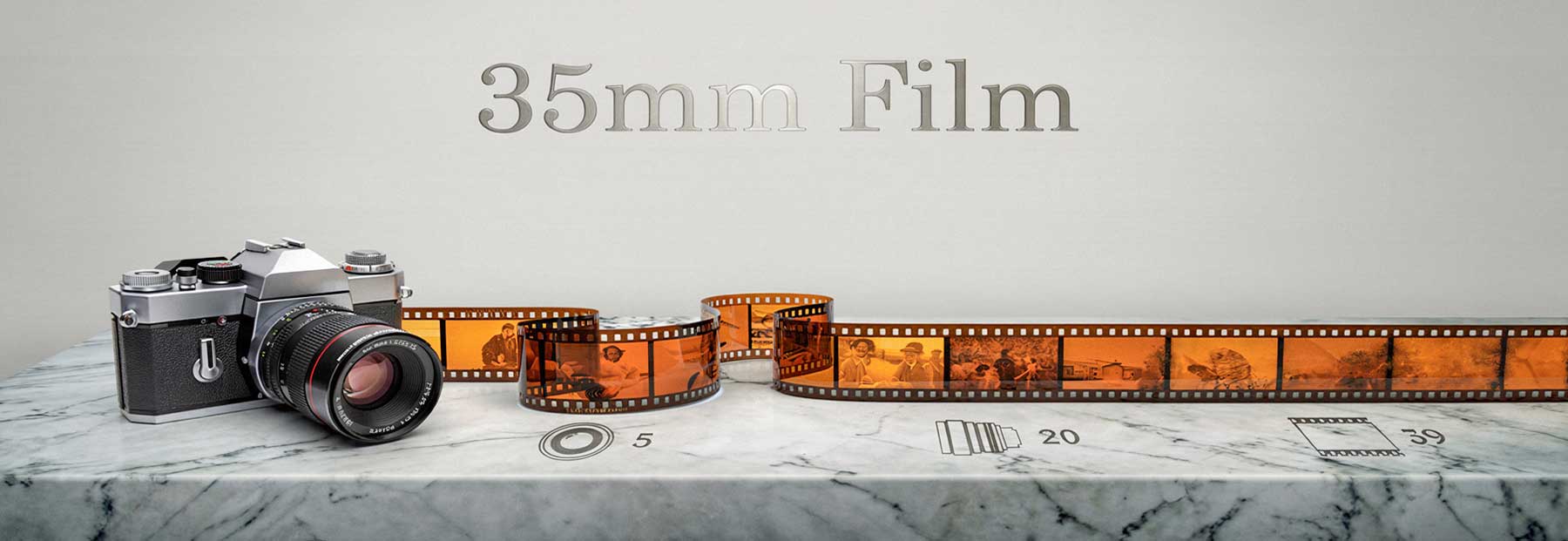
Prices for 35mm negatives
1 – 9 negatives
55p each
10 – 49
35p each
50 – 99
30p each
100 or more
25p each
35mm Film Scanning Inquiries
If you have any questions regarding our scanning service, please enter them in the box above.
Enter either your email address or telephone number depending upon how you would like us to contact you.
Potted History of 35mm (135) Film
Origins in Cinema (1890s–1910s)
The 35mm gauge began life as motion‑picture film. In the early 1890s, Edison’s assistant W. K. L. Dickson slit 70mm Eastman stock into two strips and perforated them, establishing the 35mm width and the perforation pattern that would become standard. Early experimenters soon pressed this readily available cine film into service for compact still cameras, though uptake remained limited.The Leica Revolution (1913–1925)
The decisive shift came from Oskar Barnack at Leitz. He rotated cine film horizontally and doubled the frame to 24×36 mm, creating a practical “miniature” still format. His prototype Ur‑Leica appeared in 1913–14, with the Leica I entering production in 1925. This single innovation made high‑quality photography genuinely portable and set the template for modern 35mm still cameras.Kodak’s 135 Cartridge (1934)
Early 35mm cameras relied on bulk‑loaded cine stock. Kodak changed everything in 1934 with the 135 daylight‑loading cassette, which standardised the format and made it accessible to the mass market. The 135 cartridge remains defined today by ISO 1007.Mass Adoption (1930s–1960s)
With Leica and Contax at the top end—and affordable models such as the Argus A—35mm spread rapidly. Colour arrived with Kodachrome (1936) and Kodacolor (1942). Post‑war Japanese makers, notably Nikon and Canon, accelerated the shift towards 35mm, and by the 1960s the format had overtaken 120 as the dominant choice for everyday and professional photography.Golden Age (1970s–1990s)
The format reached full maturity with: A wide range of emulsions, from fine‑grain slides to high‑speed negatives. The rise of reliable, affordable SLRs. One‑hour minilabs and compact point‑and‑shoot cameras. The 24×36 mm frame later inspired the digital term “full frame”.Contemporary Revival (2010s–Present)
Film has since returned as a niche, intentional medium. Younger photographers have rediscovered analogue aesthetics, and 35mm remains the most widely used film format thanks to its balance of quality, portability and character.UK-Photo, Broadstone Mill, Broadstone Rd, Reddish, Stockport, SK5 7DL • TEL:
07539493533
Our studio/shop is located between Manchester and Stockport. Our studio customers come from across the Northwest of England.
©2026 - Copyright uk-photo.live